
The four building blocks
- Target (contractual hours): what you would have to work this month according to your contract, for example 160 hours.
- Planned or actual: what the roster actually assigns you, or what you have worked, for example 152:00 hours.
- Carry-over: the balance you bring with you from the previous month.
- Balance: the result – the current state of your account.
The calculation
Balance = carry-over + actual hours − target hours
An example from a real monthly roster: you bring −42:06 hours with you from the previous month. 145:30 hours are planned, the contract requires 140:00. Then:
−42:06 + 145:30 − 140:00 = −36:36
So you are 36 hours and 36 minutes in the minus – five and a half hours less minus than the month before. Work in minutes when you check: 145:30 is 8,730 minutes, 140:00 is 8,400 minutes, −42:06 is −2,526 minutes. Result: −2,196 minutes, i.e. −36:36.
What changes the balance during the month
- Extra work: an additional shift, an extension – plus.
- Time off in lieu: a day off at the expense of the account – minus.
- Early finish: if you leave early at your own request, the hours are usually deducted. If the workplace sends you home, your contract or an agreement settles it.
- Sickness and leave: as a rule count like planned work and do not change the balance.
When do minus hours count?
Minus hours arise when you work less than agreed. Whether they may be charged to you depends on why: if you wanted to work but the workplace did not roster you, the employer generally bears that risk (default of acceptance, Section 615 of the German Civil Code, BGB). If you finished early yourself or took time off in lieu, it is different. How exactly your account is kept – limits, settlement periods, expiry – is set out in your employment contract, collective agreement or a works agreement.
How to check your balance
- Take the balance from the last roster as the carry-over.
- Add the planned or worked hours of this month.
- Subtract the contractual hours.
- Add or subtract time off in lieu, extra work and early finishes.
- If the result differs from the next printout, ask – the earlier, the easier it is to sort out.
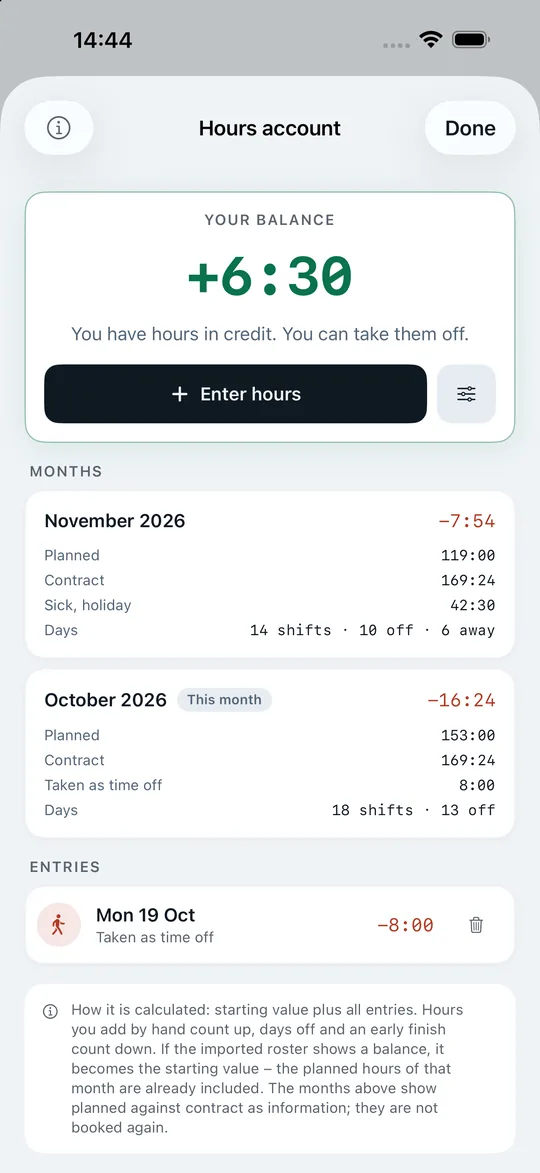
In Shiftpool the app takes the balance from the closing line of your roster as the starting value and then books everything you enter. The month cards show “planned against contract” for information, so that nothing counts twice.


Frequently asked questions
What is the difference between an hours account and a flexitime account?
In everyday use both mean the same thing: an account where plus and minus hours are collected. Strictly speaking, flexitime refers to a model in which you choose your own start and finish times; that is rare in shift work, but the account exists all the same.
Can overtime expire?
That depends on your contract, collective agreement or a works agreement. Some rules provide for upper limits or settlement periods. Check your workplace’s rules and reduce high balances in good time.