
The basic rule: 11 hours uninterrupted
After the end of your daily working time you are entitled to an uninterrupted rest time of at least eleven hours (Section 5(1) of the Working Hours Act, Arbeitszeitgesetz). Uninterrupted means the eleven hours must not be broken up by work. A phone call during which you work for an hour starts the rest time all over again afterwards.
It is measured from the actual end of the shift to the start of the next one. If your late shift ends at 22:00, the next shift may start at 9:00 at the earliest.
Examples from everyday shift work
| Shift | Next shift | Rest time |
|---|---|---|
| Late until 22:00 | Early from 6:00 | 8 h – too short |
| Late until 20:45 | Late from 12:30 | 15 h 45 min |
| Night until 6:00 | Late from 13:30 | 7 h 30 min – too short |
| Night until 6:00 | Night from 21:30 | 15 h 30 min |
| Early until 14:30 | Early from 6:00 | 15 h 30 min |
The classic is the “quick changeover” from late to early. It slips through easily when swapping: you are happy to take on an early shift – and overlook that you are on a late shift the evening before.
Exceptions: where the rest time may be shorter
For certain sectors the law allows a reduction of up to one hour, so to ten hours (Section 5(2) ArbZG). This applies in
- hospitals and other facilities for the treatment, nursing and care of people,
- restaurants and other establishments for catering and accommodation,
- transport companies, broadcasting, and agriculture and animal husbandry.
The condition: every reduction is made up within one calendar month or within four weeks by extending another rest time to at least twelve hours.
Beyond that, the law allows deviations by collective agreement or by a works agreement based on a collective agreement (Section 7 ArbZG) – for example a reduction of up to two hours if the nature of the work requires it and compensation is provided for. Civil servants are covered not by the Working Hours Act but by the federal and state working-time regulations, which contain their own rules. So check your collective agreement or ask your works or staff council.
Several days in a row
Besides the daily rest time there is the weekly one: under the EU Working Time Directive you are entitled to at least 24 hours of uninterrupted rest per seven-day period, in addition to the eleven hours (Directive 2003/88/EC, Article 5); the reference period may be up to 14 days. In German law something similar follows from Sunday and public-holiday rest with compensatory rest days (Sections 9 to 11 ArbZG). Anyone who ends up with seven or more shifts in a row through swaps should therefore look closely.
How to work it out before a swap
- Take the end of your shift on the previous day and the start of the shift you want to take on.
- Count the hours in between. If midnight falls in between, count the remainder up to 24:00 plus the hours from 0:00.
- Do the same from the end of the shift you are taking on to your next shift.
- If either of the two figures is below eleven hours, talk to the supervisor before the swap.
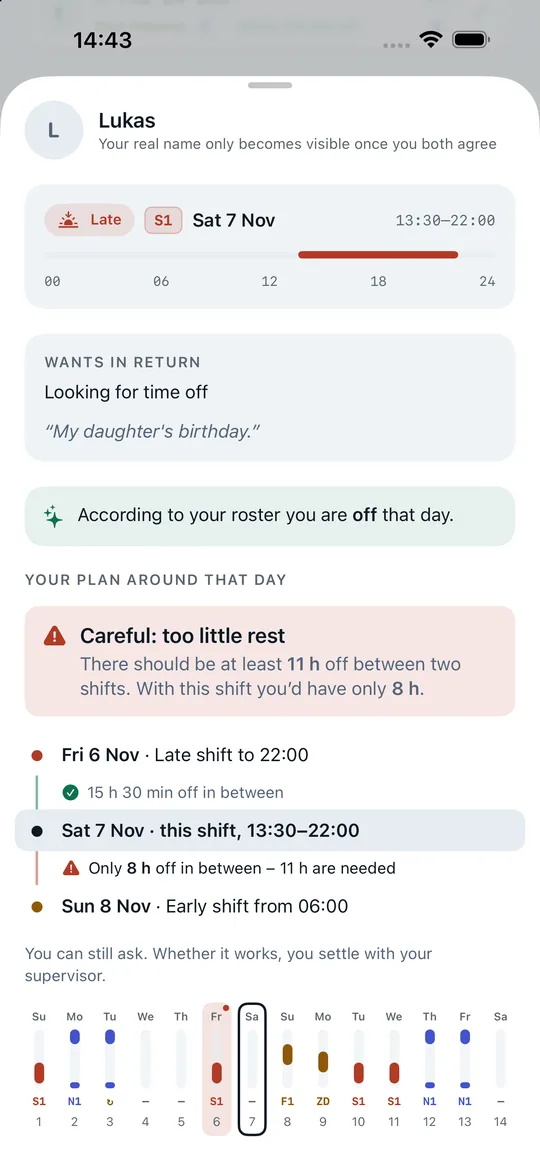
In Shiftpool this happens automatically: when you open an offer, the answer is right at the top in one sentence – “Fits – you have enough time off”, “Careful: too little rest” or “Won’t work: the shifts overlap”. Below it the app shows the chain from your own roster: the day before, the free time in between, the offered shift, the free time after it, the day after. Below eleven hours – and from the seventh working day in a row – it warns you. Without a known time, the app honestly says “Check it yourself” rather than guessing.


Frequently asked questions
Does the commute count as rest time?
Yes. The normal journey between home and workplace is not working time and therefore counts as rest time. With long commutes it gets correspondingly tight.
Can I voluntarily waive my rest time?
No. Rest time serves to protect your health and is not negotiable. Even if you agree, your employer may not deploy you before the rest time has elapsed – exceptions exist only through the statutory and collective-agreement rules.
What about breaks during the shift?
Breaks are something different from rest time: for more than six hours of work you are entitled to at least 30 minutes, for more than nine hours 45 minutes (Section 4 ArbZG). They can be split into periods of at least 15 minutes.