
The key terms
- Cycle (rota): the number of days after which a plan repeats.
- Shift group: a group of employees who run through the cycle together. Several groups run staggered so that every shift is covered.
- Semi-continuous: round-the-clock operation on weekdays, a break at the weekend.
- Fully continuous (continuous shift system): 24 hours on 7 days, including public holidays.
- Forward rotating: early → late → night. Considered easier on the body in occupational medicine than backward rotation, because the body clock shifts later more easily.
The common patterns at a glance
| Pattern | Sequence | Cycle | Shift length |
|---|---|---|---|
| Two-shift | A week of earlies, a week of lates | 14 days | 8 h |
| Three-shift (rotating shifts) | A week each of early, late, night | 21 days | 8 h |
| 2-2-2-4 | 2 early, 2 late, 2 night, 4 off | 10 days | 8 h |
| Panama (2-2-3) | 2 on, 2 off, 3 on, 2 off, 2 on, 3 off | 14 days | 12 h |
| DuPont | 4 nights, 3 off, 3 days, 1 off, 3 nights, 3 off, 4 days, 7 off | 28 days | 12 h |
| 4 on, 4 off | 4 shifts, 4 off | 8 days | 12 h |
| 24/48 | 24 h shift, 48 h off | 3 days | 24 h |
| Kelly | 24 on, 24 off, 24 on, 24 off, 24 on, 96 off | 9 days | 24 h |
2-2-2-4: the classic of the continuous shift system
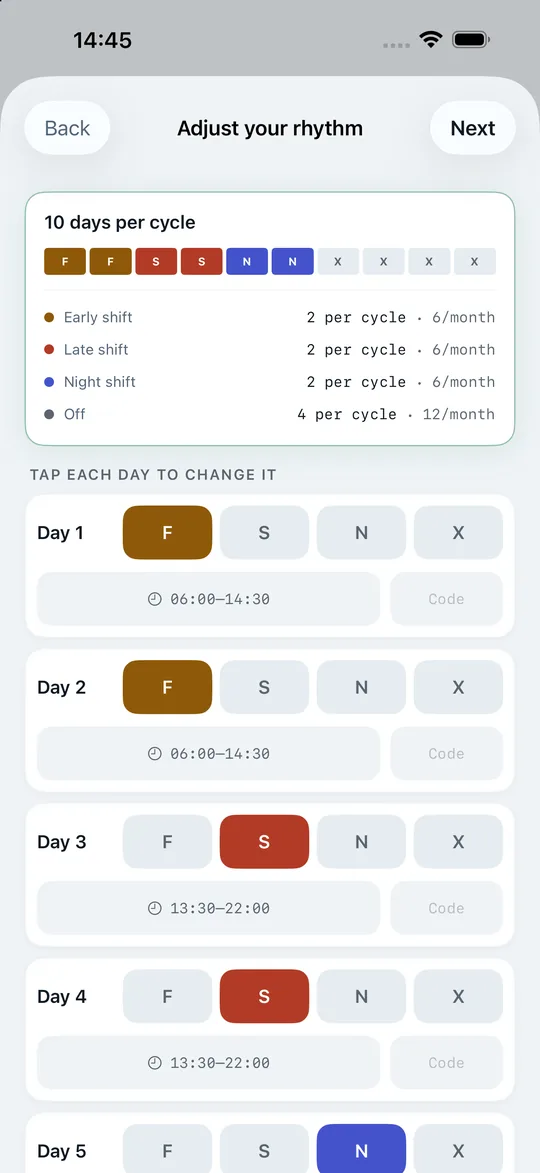
Two early shifts, two late shifts, two night shifts, then four days off: after ten days the cycle starts again. The pattern rotates forward and offers regular long blocks of time off. For round-the-clock operation with 8-hour shifts it needs, by the arithmetic, five shift groups: each group works six days out of ten, and three shifts have to be covered each day.
The drawback: weekends sometimes fall in the block of days off, sometimes not. But if you know your cycle, you can predict exactly which weekends are free – across the whole year.
Panama (2-2-3): every other weekend off
The Panama or Pitman pattern works with 12-hour shifts and four groups. The sequence “2 on, 2 off, 3 on, 2 off, 2 on, 3 off” repeats after 14 days and ensures that every other weekend is off – including the Friday or the Monday. On average it comes to 42 hours a week. The downside is the long working days.
DuPont: four weeks, one long block off
DuPont combines 12-hour day and night shifts in a 28-day cycle with four groups. The highlight is a block of seven days off at the end. The pattern is common above all in the chemical industry and in power stations. Because the cycle is four weeks long, you need two runs to recognise it reliably from a roster.
24/48 and Kelly: the 24-hour shift
In 24/48, a 24-hour shift is followed by a 48-hour break. The pattern is common mainly in fire services in North America; the Kelly pattern extends every third break to 96 hours. In German-speaking countries, 24-hour shifts are found mainly in professional fire brigades, often with on-call duty included and their own working-time rules.
Annual shift plan with groups
Instead of a pattern, many workplaces post a whole annual plan – at airports, in the police, in healthcare as a framework roster covering four to six weeks. For each day it only says “shift” or “off”; the times come later with the monthly roster. Here too there is almost always a cycle behind it. In a real annual plan from aviation security, each group runs in a 21-day cycle with 14 shifts and 7 days off, and the next group does exactly the same, just 14 days later.
Your pattern in Shiftpool
In Shiftpool you enter your pattern once – from a template for each pattern above, copied from a colleague in your shift group, or recognised from your roster. Cycles of up to 366 days are possible. The app checks the position day by day against your real roster and then shows you the whole year.


Frequently asked questions
Which shift pattern is the healthiest?
In general, forward-rotating systems with few night shifts in a row and enough recovery afterwards are considered easier on the body. Germany’s Working Hours Act requires night and shift work to be designed according to established ergonomic findings (Section 6(1) ArbZG). But which pattern suits you also depends on your family, your commute and your own sleep rhythm.
How do I find out which cycle I have?
Count the days in your annual plan until the pattern of shifts and days off repeats. Or let Shiftpool work it out: you type in the days off of one month and the app finds the cycle length itself.
What is the difference between rotating shifts and shift work?
Shift work generally means that the same workstation is staffed by different people one after another. Rotating shifts means that you yourself regularly switch between different shift positions, for example early, late and night.