
Do I have a right to swap my shift?
No – at least not under the law. In Germany, your employer decides when you work as part of its right to give instructions (Section 106 of the Trade Regulation Act, Gewerbeordnung), limited by your employment contract, collective agreement, works agreement and the Working Hours Act (Arbeitszeitgesetz). A swap with a colleague changes that allocation. So it only takes effect once the responsible person agrees – usually the shift or ward supervisor.
In practice, employers are often open to swap requests as long as the shift is covered and the qualifications match. Many workplaces have fixed rules for this, for example in a works agreement: by when a swap must be requested, who it goes through and which limits apply.
What happens if I swap without approval?
If your colleague turns up for the shift, perhaps nobody notices. If she does not, you are the one missing – and without excuse, because you were the one rostered. That can lead to a written warning. An unapproved swap can also breach rest times or maximum working hours, which the employer is responsible for keeping. So: every swap needs an okay – and both of you should know it is there.
What role does the works council play?
The start and end of daily working hours and how they are spread across the days of the week are subject to co-determination (Section 87(1) no. 2 of the Works Constitution Act, Betriebsverfassungsgesetz). Rosters and shift plans are part of that. Where there is a works council, it has therefore often had a say in how swaps work. In the public sector the staff council takes on this role. Ask whether such an agreement exists – it gives binding answers to many questions.
Who gets the premiums for night or public-holiday work?
Shift premiums are almost always tied to the work actually done: whoever works the night or the public holiday gets the premium. That is one reason why public-holiday shifts are so sought after – some want the money, others want to be with their family. The exact rules are in your collective or employment agreement; if in doubt, ask the HR department before you swap.
Five rules for a swap without misunderstandings
- Both say yes explicitly. “I’ll have a look” is not a yes. An arrangement only counts once both have agreed – preferably in writing.
- One person reports the swap. Decide who calls the supervisor. Otherwise nobody calls – or both do, with different information.
- Check rest time and qualifications. Does the new shift fit with the shifts before and after it? Is your colleague even allowed to cover that area? Work out the rest time
- Record the outcome. Approved or declined – both of you need to know. Otherwise two people turn up on the day, or nobody does.
- Put the swap into your roster. An approved swap that is not in your own calendar gets forgotten.
Where and how to swap? Three ways compared
In person or by phone works in small teams. The bigger the group, the harder it is to reach the one person who is actually off on that day.
In the group chat you reach many people at once – but requests get lost among everything else, and everyone sees everyone else’s phone number. Why WhatsApp groups are poorly suited to swapping
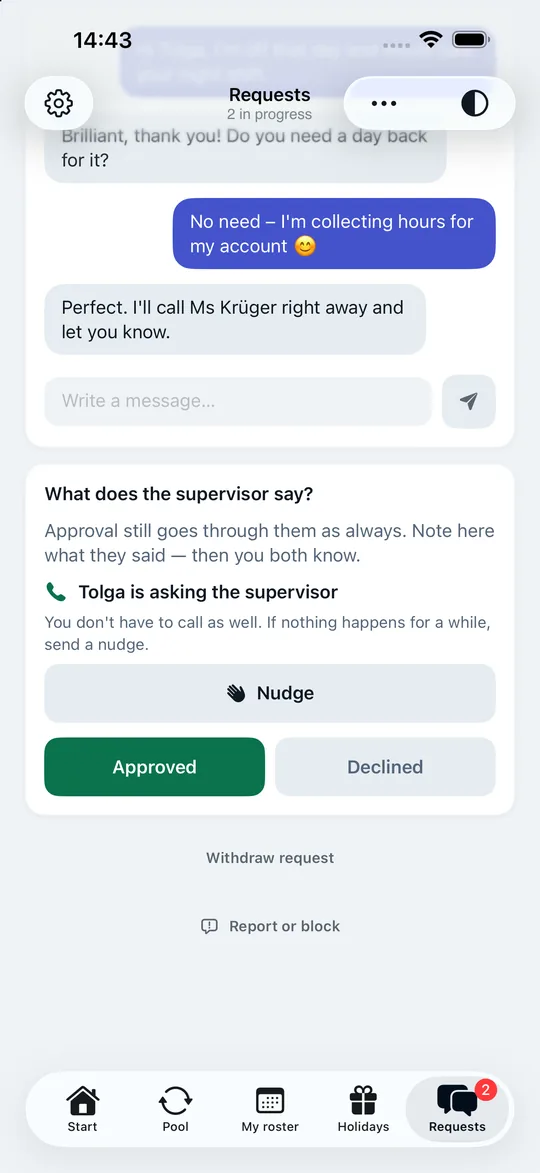
With a swap app every offer is listed once, with the day, the time and what is wanted in return. Shiftpool is such an app, built for employees rather than the employer: every swap has a visible status (requested, names shared, agreed, approved), the app records who asks the supervisor, and it checks the rest time against your own roster beforehand. It does not change your workplace’s roster – approval stays with the supervisor.


Frequently asked questions
Can my employer refuse a shift swap?
Yes. As a rule there is no entitlement to a particular swap. A refusal must not be arbitrary, though; works agreements and collective agreements can set criteria.
Do I have to give a reason for the swap?
Usually not. What matters is that the shift is covered and the rules are followed. Some workplaces ask anyway – whether you answer is up to you.
Can I swap with someone from another department?
Only if that person is allowed to work in the area and both supervisors agree. Often swaps are only intended within one ward, department or shift group.